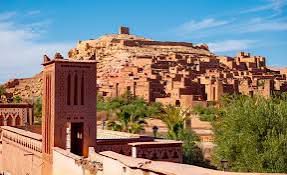
The ksar , a group of earthen buildings surrounded by high walls, is a traditional pre-Saharan habitat. The houses crowd together within the defensive walls, which are reinforced by corner towers. Ait-Ben-Haddou, in Ouarzazate province, is a striking example of the architecture of southern Morocco.
tuneFilter
Ksar of Aït-Ben-Haddou
Outstanding Universal Value
Brief summary
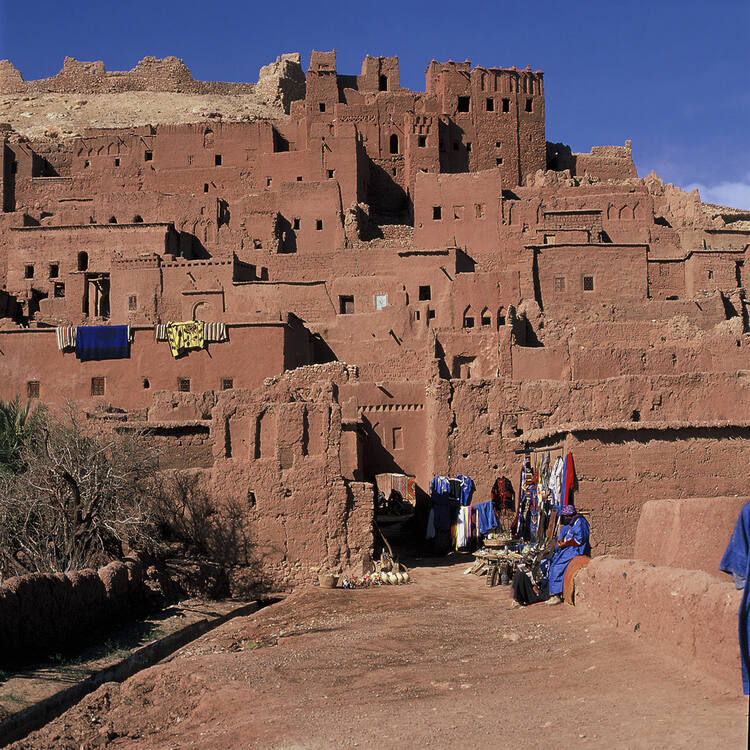
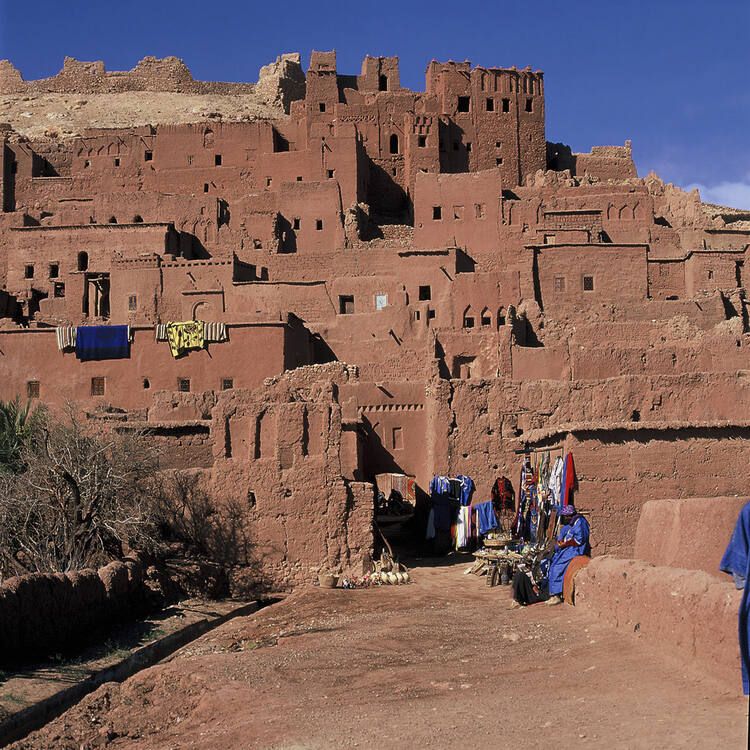
Located on the foothills of the southern slopes of the High Atlas in the province of Ouarzazate, the site of Aït-Ben-Haddou is the most famous of the ksour of the Ounila Valley. The Ksar of Aït-Ben-Haddou is a striking example of the architecture of southern Morocco. The Ksar is a group of essentially collective dwellings. Inside defensive walls reinforced with corner towers and pierced by a chicane gate, there are numerous residential houses, some modest, others resembling small urban castles with their high corner towers decorated on the upper part with decorative motifs in raw brick, but also buildings and community spaces. It is an extraordinary group of buildings offering a complete panorama of pre-Saharan earth construction techniques. The oldest buildings do not appear to date back to the 17th century, although their structure and technique have spread since a very early period in the valleys of southern Morocco. The site is also said to have been one of the many trading posts on the trade route that linked ancient Sudan to Marrakech via the Dra Valley and the Tizi-n’Telouet Pass. Architecturally, the structure of the habitat is presented in the form of a compact, closed and suspended grouping. The public spaces of the ksar consist of a mosque, a public square, grain threshing areas outside the ramparts, a fortification and a granary at the top of the village, a caravanserai, two cemeteries (Muslim and Jewish) and the sanctuary of Saint Sidi Ali or Amer. The Ksar of Aït-Ben-Haddou is a perfect synthesis of the earthen architecture of the pre-Saharan regions of Morocco.
Criterion (iv): The Ksar of Aït-Ben-Haddou is an eminent example of a ksar in southern Morocco, illustrating the main types of earthen constructions observed from the 17th century in the valleys of the Dra, Todgha, Dadès and Souss.
Criterion (v): The Ksar of Aït-Ben-Haddou illustrates the traditional earthen habitat, representative of southern Moroccan culture, which has become vulnerable under the effect of irreversible socio-economic and cultural changes.
Integrity (2009)
All the structures that make up the ksar are within the boundaries of the property and the buffer zone protects its environment. The earthen buildings are made very vulnerable to the lack of maintenance and continuous repair due to the abandonment of the ksar by its inhabitants. CERKAS (Centre for the Conservation and Rehabilitation of Architectural Heritage of the Atlas and Sub-Atlas Zones) ensures, not without difficulty, that the visual integrity of the property is respected.
Authenticity (2009)
Compared to other ksour in the region, the Ksar of Aït-Ben-Haddou has preserved its architectural authenticity in terms of shapes and materials. The architectural style is well preserved and the earthen constructions adapt perfectly to the climatic conditions and harmonize with the natural and social environment.
The large houses at the bottom of the village, whose decorative motifs have been preserved, are well maintained. The materials used for construction remain earth and wood. The attempts to introduce cement have so far failed, thanks to the continuous monitoring of the Committee for the Control of Offenses (Rural Municipality, Urban Planning Division, Urban Agency, CERKAS). Only a few lintels and reinforced concrete frames have been able to escape its vigilance, but they have been hidden under earth coatings. Particular attention is also paid to the doors and windows overlooking the alleys, to ensure that metal does not replace wood.
Protection and management needs (2009)
The protection measures are mainly based on the various laws on the classification of historical monuments and sites, particularly Law 22-80 on Moroccan heritage. The Ksar of Ait-Ben-Haddou currently has a management plan that extends over 5 years (2007-2012). This management plan is the result of two years of reflection and workshops involving all the people and institutions concerned by the future of the site, in particular the local populations. The recommendations of this plan are currently being implemented. In addition, two management committees have been created (a local committee and a national committee) in which all stakeholders are represented and collaborate in decision-making. At the same time as it manages the property, CERKAS ensures the coordination of the implementation of this management plan

 Morocco Expedition Tours