
What is riad in morocco as accommodation to stay
How do you pick where to stay when you’re travelling? Three things top my list: a good location, a comfortable bed, and a shower with hot water. There’s nothing better after a long day of exploration and adventure than a place nearby to get a hot shower and a good night’s sleep.
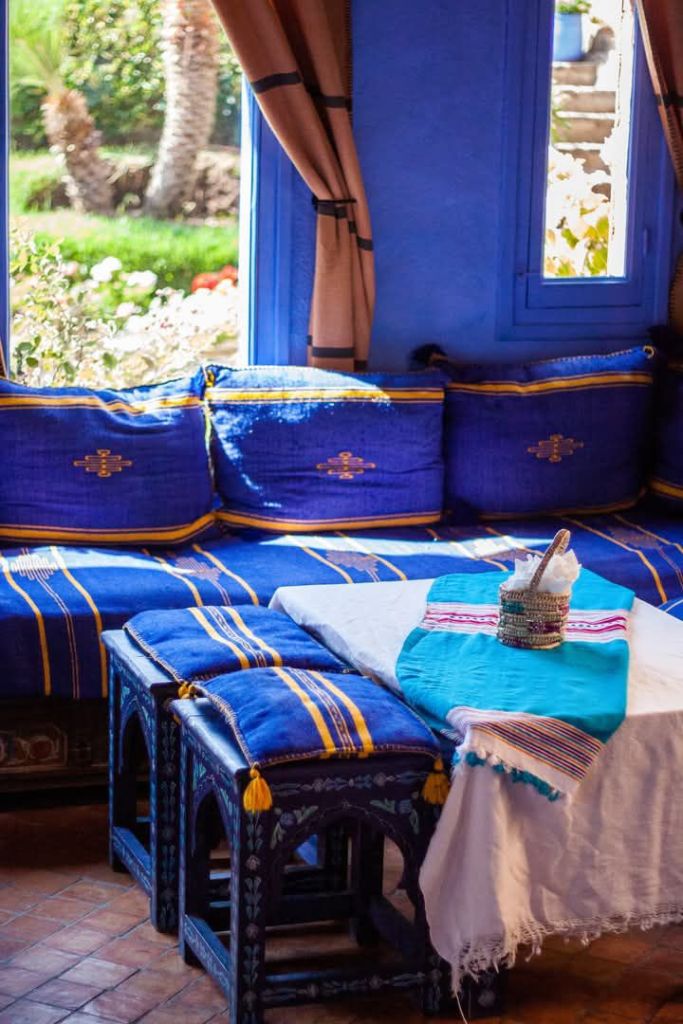
Finding good accomodations in Morocco is no simple matter. It’s worth doing your research before you make your final decision.
Today’s article, dear readers, will help you make that choice. We’ll talk about what a riad is and how it’s different from hotels in Morocco.
Let’s get started!
What is a Riad?
In general, a riad is a building with rooms and common areas around a central courtyard. Of course, riads aren’t a modern day phenomenon. They’ve existed in Morocco for centuries.
Historically, the houses in Moroccan medinas were almost always inwardly focused with a large courtyard at the center. There were two reasons for this: the weather and the culture. Small exterior windows and a central courtyard helped to keep a constant, comfortable temperature inside the home. Moroccans have always valued privacy and don’t like to show off, they prefer houses that look modest on the outside and lavishly furnish them with beauty in every detail on the inside. The ample courtyard at the center also provides a pleasant space for activities with the family.

If you’ve ever been to Andalusia in Southern Spain, you’ll notice a lot of architectural similarities, since that region was culturally connected to Morocco for 800 years. This style of architecture bears some similarities also to the much older Roman domus.
“Riad” means “garden” in Arabic and only the finest of the medina houses with sumptuous central courtyards were worthy of the name.
Riads were the expansive villas of the wealthiest families with a panoply of rooms (some for housing servants) and a more elaborate courtyard with a garden or, at least, a sizable fountain and some greenery.
Don’t get me wrong. The other houses in the medina weren’t small by any stretch of the imagination because they housed several generations of the family at once. Even today it’s not strange to see a newly built house with the upper part unfinished, waiting for a son to get married so they can keep building upwards.
In the following image you can see that riads are few and far between within the fabric of a medina.

If we stick to its current definition, nowadays a “riad” is any house in the medina with a central courtyard that welcomes travelers, regardless of the size of its courtyard or how beautiful it is.
So, we can distinguish two types of riads: (1) the 2-storey type with 5 to 8 rooms, and (2) the authentic traditional riads which are usually 3 to 4 storeys with more than 10 rooms (but normally no more than 20), both of them set up as accommodations for travelers. Sometimes the first type is also called “dar” (which simply means “home” in Arabic) so as not to create confusion with the traditional meaning of the term.
Both types are an amazing experience. You’ll walk through the unassuming entranceway and be dazzled by the interior design. Traditional riads are more impressive, but the dars are more intimate. I can’t even recommend one over the other. They’re both amazing.
Space in a medina is limited, so oftentimes riads don’t have large, open lobbies. Think of it as a boutique hotel with a small reception area, rooms with private bathrooms, a cozy common area, breakfast included, etc.

The atmosphere is often so intimate and the service so personalized that it seems like you’re staying at the home of a well-to-do friend or relative. They’re often run by Europeans who fell in love with Moroccan culture and ended up buying a property and converting it into a guesthouse. So, while they usually take pains to preserve authentic local flavor when it comes to decor, they provide service with a familiar touch of Western culture.
When it comes to riad décor, there are two schools: Traditionalist, very ornate and complex, and Modern Traditionalist, with one foot in tradition (white plaster walls, carved wood as a base) and the other firmly grounded in the minimalist approach.
Riads vary from city to city also because of differences in climate. Marrakech is dry and hot, so you’ll see mainly stucco-clad walls and likely a pool in the courtyard. In the more humid and cool climate of the north, tiled walls are more common and the courtyard is a place for guests to walk through or to simply sit and relax.
Here’s a gallery of riads around Morocco. See if you can tell which ones are found in dry and humid climates, and which ones are converted medina houses and which are historically authentic riads:

 Morocco Expedition Tours